Zeer Pot — A Fridge That Runs on Nothing
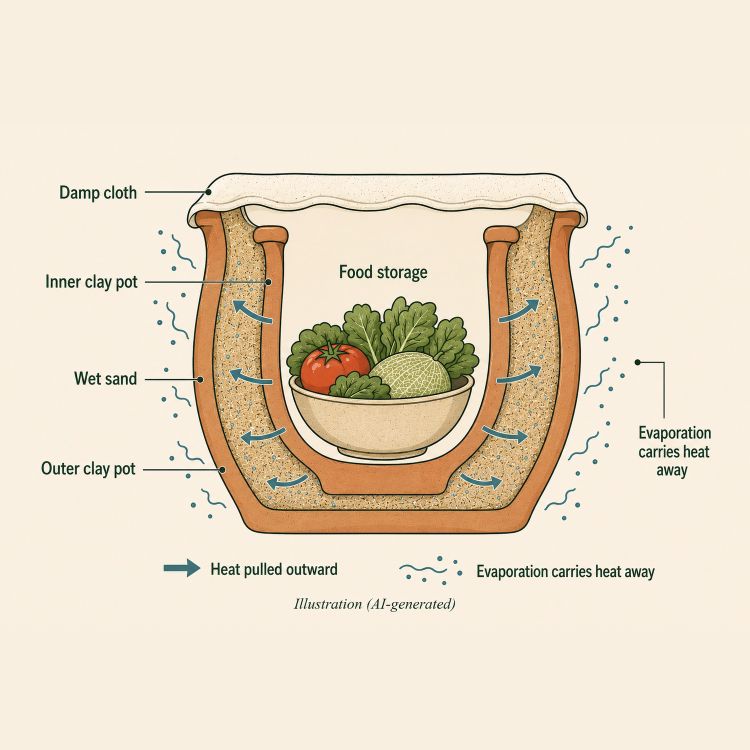
One clay pot inside another, wet sand between them. In hot dry air, it keeps vegetables fresh for weeks — no electricity, no moving parts.
At a glance
• Origin: Kano State, northern Nigeria — Mohammed Bah Abba (1964–2010), teacher and clay-pot maker.
• Maturity: Scaled — 5+ independent replications across multiple countries and climates.
• Cost: low — two unglazed clay pots, sand and water. We have not yet found a reliable source for a local price.
• Build time: 15–20 minutes to assemble. A child can build one.
• Licence: Open — free for any use; no patent is known to have been filed.
The story
In the late 1990s, more than 90% of villages in Mohammed Bah Abba’s region of northern Nigeria had no electricity — no refrigeration, in temperatures that regularly passed 40°C. Tomatoes, peppers, and eggplants spoiled within two or three days of harvest, costing farming families their income, especially the women who sold produce at market.
Abba came from a family of traditional potmakers and drew on a far older cooling principle: unglazed clay stays cool through evaporation. Practical Action notes that a single-pot clay water cooler, the zeer, has been used in Sudan “since time immemorial”. He combined it with a simple two-pot design — one pot nested inside another with wet sand between — to make an electricity-free refrigerator anyone could build from local materials.
He hired local potmakers to produce a first batch of 5 000 pots. To reach communities with low literacy, he even commissioned a recorded play by local actors to show how it worked. In 2000 he won the Rolex Award for Enterprise and used the entire $75 000 prize to scale it beyond that first batch. He died in 2010, at 46. Others carried the idea further: in 2001 Practical Action’s Sudan country director, Mohammed Majzoub, heard of Abba’s work and began a clay-refrigerator project there, training 21 women from the Al Fashir Association for Earthenware Manufacturing to make the pots.
A language note travellers love: “Zeer” is simply the Arabic word for pot — so “Zeer pot” literally means “pot pot.” It’s in good company: the Sahara Desert means “Desert Desert.”
The problem it solves
Fresh produce spoils within two to three days in hot, dry climates without refrigeration — causing food waste, lost income, and poorer nutrition for farming families.
It matters most in hot arid and semi-arid regions with little or no electricity: sub-Saharan Africa, the Sahel, parts of the Middle East, and semi-arid South Asia — and especially for women farmers who must sell perishable produce quickly.
How it works
Put a 5cm layer of sand in the bottom of a large unglazed clay pot, set a smaller unglazed pot inside, and fill the gap between them with sand. Soak the sand with water, put food in the inner pot, and cover it with a damp cloth.
As water evaporates from the wet sand through the porous outer clay, it draws heat away from the inner chamber — the same physics that makes you feel cold stepping out of a pool. Re-wet the sand twice a day. That’s the whole machine.
What to expect — and what not to
Tomatoes can last about three weeks instead of two to three days; leafy greens keep considerably longer too.
• On a hot, dry day the inner pot stays noticeably cooler than the outside air. How much cooler depends on heat, dryness and airflow, so measure it where you live.
• Needs a hot, DRY climate and good airflow — the drier the air, the better it works. Keep it shaded; direct sun overheats the outer pot.
• Does NOT work in humid or tropical climates (above ~60% humidity evaporation stalls), in enclosed airless spaces, or for meat, dairy, or anything needing true-cold storage.
When it doesn’t work — the honest part
The most common reason it underperforms is simple: humidity. People try it in the wrong climate and are disappointed. The honest rule is that this is a dry-climate tool — brilliant where it fits, useless where it doesn’t. Check your local humidity before you build.
The other frequent failure is a glazed pot bought by mistake — glaze blocks evaporation and the cooling never happens. Wet a small patch before buying: on the right pot, the water soaks straight into the clay.
Credit & licence
The two-pot fridge was developed and spread by Mohammed Bah Abba (1964–2010), Kano State, Nigeria — winner of the 2000 Rolex Award for Enterprise — building on a clay-cooling tradition far older than him, and carried further by others, including Practical Action’s work in Sudan. Open, free for any use, commercial or not; no patent is known to have been filed. This entry documents the design as permanent prior art so no one can enclose it later.
The pot-in-pot has no central owning organization today — Abba died in 2010. Communities building one can point to open resources such as Practical Action’s guidance.
Sources: Practical Action, “Zeer Pots: One ingenious solution to fresh produce for longer”, 4 April 2022 — https://practicalaction.org/news-media/2022/04/04/zeer-pots-one-ingenious-solution-to-fresh-produce-for-longer/ (archived: https://web.archive.org/web/20240527153900/https://practicalaction.org/news-media/2022/04/04/zeer-pots-one-ingenious-solution-to-fresh-produce-for-longer/) · Practical Action Sudan with the Al Fashir and Gemayer Associations for Earthenware Manufacturing, “Clay Based Technologies” (manual; mirror copy held by RACHEL) — https://rachel.core2learn.org/modules/en-practical_action/Manufacturing,%20handicraft,%20process%20industries/Pottery%20and%20ceramics/clay-based-tech-book.pdf (archived: https://web.archive.org/web/20250216034429/https://rachel.core2learn.org/modules/en-practical_action/Manufacturing,%20handicraft,%20process%20industries/Pottery%20and%20ceramics/clay-based-tech-book.pdf) · Practical Action, “The Clay Refrigerator” (build guide; mirror copy held by RACHEL) — https://rachel.core2learn.org/modules/en-practical_action/Manufacturing,%20handicraft,%20process%20industries/Pottery%20and%20ceramics/clay_based_technology_refrigerator.pdf (archived: https://web.archive.org/web/20250216030421/https://rachel.core2learn.org/modules/en-practical_action/Manufacturing,%20handicraft,%20process%20industries/Pottery%20and%20ceramics/clay_based_technology_refrigerator.pdf) · Voice of America, “A Cool Way to Keep Food From Spoiling” — https://learningenglish.voanews.com/a/a-23-2009-02-07-voa4-83141622/129843.html (archived: https://web.archive.org/web/20260518192348/https://learningenglish.voanews.com/a/a-23-2009-02-07-voa4-83141622/129843.html) · Time, “Inventor: Mohamed Bah Abba” (Best inventions of 2001) — https://content.time.com/time/specials/packages/article/0,28804,1936165_1936254_1936632,00.html (archived: https://web.archive.org/web/20261024004939/https://content.time.com/time/specials/packages/article/0,28804,1936165_1936254_1936632,00.html)