Zaï Pits — Bringing Dead Soil Back to Life
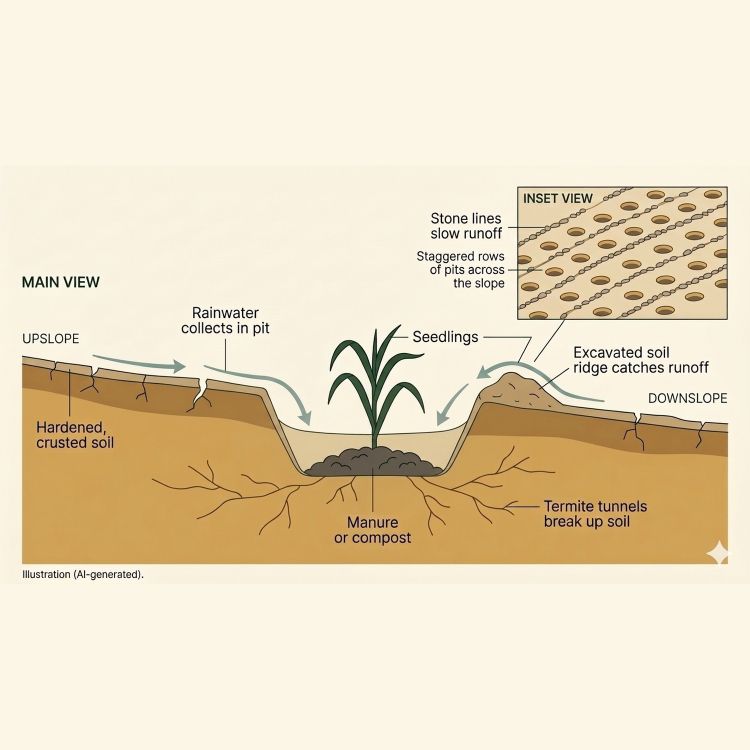
Small holes dug by hand into ground too hard for rain to enter. A handful of manure in each one. In the Sahel, this brought back land everyone had given up on.
At a glance
• Origin: Yatenga Province, northern Burkina Faso — Yacouba Sawadogo (died 3 December 2023), farmer. An ancient technique he revived and improved.
• Maturity: Scaled — practised across Burkina Faso, Mali and Niger, with documented trials in Kenya.
• Cost: No money required. A hand hoe or pickaxe, and manure you already have.
• Labour: This is the real cost. Roughly 100 person-days of digging per hectare, in the dry season, by hand.
• Licence: Open — ancient community knowledge, no patent, free to anyone.
The story
In the early 1980s the Sahel was dying. Twelve years of drought had turned farmland to dust. Rain still fell, but the soil had set so hard that water ran straight off it, carrying the topsoil away and making each storm worse than the last. Farmers walked away from their land. Villages emptied.
In northern Burkina Faso, a farmer named Yacouba Sawadogo looked at his family’s abandoned fields and refused to accept it. He remembered zaï — an old technique of digging small planting pits into hard ground, largely forgotten in better years.
He did not simply revive it. He made the pits wider and deeper. He put manure and compost in each one, which the old method had never done systematically. And he laid lines of stones across the slope to slow the runoff and push water into the pits.
The manure did something he had not planned for. It drew termites, and the termites bored channels through the crust, opening the soil far deeper than a hoe could reach.
Land that had been bare grew into a forest at Gourga. How large it became is genuinely contested, and the figures differ by more than twofold. Sidwaya, Burkina Faso’s national daily, reported a forest of about fifteen hectares on the day he died. The Right Livelihood Foundation, which gave him its award in 2018, describes almost forty hectares holding more than sixty species of trees and bushes. Both may be right: Gourga was his native village, and Sidwaya notes that it has since been swallowed by the city and is now sector 15 of Ouahigouya — so a forest measured in the 2000s and a forest measured in 2023 are not necessarily the same forest, and the direction of travel is down. He did not keep it to himself: he went on training other farmers, mainly young men and women, for the rest of his life. The water came back too. The Right Livelihood Foundation reports that in some cases well levels have risen by five to seventeen metres, and that villages which had been short of drinking water for eight months a year now have water all year round. One village shows what that looks like: in Ranawa, also in Yatenga, every well ran dry at the end of the 1984 rainy season; after farmers there dug planting pits, laid stone lines and let trees regrow, a 2002 survey found all the village’s wells holding water through the whole year, and they still were in June 2020.
Yacouba Sawadogo died on 3 December 2023. This entry exists so his knowledge travels further and faster than he could carry it.
What it does
Zaï works where rainfall is roughly 300 to 800 mm a year — low, unpredictable, and arriving in hard downpours that run off baked ground instead of soaking in.
Each pit does four things at once. It breaks the hardened crust so water can enter. It catches runoff and holds it where a plant can reach it. It concentrates scarce manure exactly at the roots instead of scattering it across a whole field. And it attracts termites, whose tunnels carry water and nutrients deeper than digging alone ever could.
What to expect — and what not to
Where it works: degraded, crusted dryland soil on slopes under 5%, in the 300–800 mm rainfall band, where soil-dwelling termites are present.
Yields: reported gains vary widely by site, soil and season. The most-cited figure is up to a 500% increase on severely degraded land where the technique is well executed. Treat that as a documented best case, not a planning baseline. Most farmers should expect real improvement, not a fivefold one.
Where it does not work: slopes above 5%, where pits can worsen erosion instead of preventing it. Wetter climates above about 800 mm, where waterlogging becomes the risk instead of drought. And regions without soil-dwelling termites, where results are meaningfully weaker.
The honest cost: digging is hard physical work, possible only in the dry season, and one person manages roughly 100 pits a day. At around 10 000 pits per hectare, that is roughly 100 person-days for a single hectare — usually spread across a family and several weeks. No money changes hands. That does not make the work free.
How it is done
Dig pits 20–30 cm wide and 10–20 cm deep, spaced roughly 60–80 cm apart, in staggered rows across the slope. Pile the excavated earth into a small ridge on the downhill side of each pit so it catches runoff. Put about a handful of manure or compost in each pit. Sow sorghum, millet or tree seeds when the rains arrive. Stone lines laid across the slope are not essential, but they make a substantial difference.
How we checked this
The termite effect is not a guess. Soil researchers working in Burkina Faso measured it directly in the nineteen nineties — they dug into crusted ground and recorded how much more water got through where termites had been at work. Others have since tested it and found the same thing. Their full write-ups are in the sources at the bottom of the entry, if you want to read them yourself.
The yield figure is shown as a best case rather than something to expect, because the reports vary and we would rather you plan on the honest number.
Sources: Sidwaya, “Hommage à Yacouba Sawadogo: le « fou de la forêt de Gourga » s’en est allé”, 3 December 2023 (French) — https://www.sidwaya.info/hommage-a-yacouba-sawadogo-le-fou-de-la-foret-de-gourga-sen-est-alle/ (archived: https://web.archive.org/web/20260719031225/https://www.sidwaya.info/hommage-a-yacouba-sawadogo-le-fou-de-la-foret-de-gourga-sen-est-alle/) · Right Livelihood Foundation, Yacouba Sawadogo laureate page — https://rightlivelihood.org/the-change-makers/find-a-laureate/yacouba-sawadogo/ (archived: https://web.archive.org/web/20260707150825/https://rightlivelihood.org/the-change-makers/find-a-laureate/yacouba-sawadogo/) · Mando, Stroosnijder and Brussaard, “Effects of termites on infiltration into crusted soil”, Geoderma 74, 1996, pp. 107–113 — https://doi.org/10.1016/S0016-7061(96)00058-4 · Kaiser, Lepage, Konaté and Linsenmair, “Ecosystem services of termites (Blattoidea : Termitoidae) in the traditional soil restoration and cropping system Zai in northern Burkina Faso”, Agriculture, Ecosystems and Environment 236, 2017, pp. 198–211 — https://www.documentation.ird.fr/hor/fdi:010068943 (archived: https://web.archive.org/web/20190910105644/https://www.documentation.ird.fr/hor/fdi:010068943) · Belemviré, Ouedraogo, Reij and Tappan, “History and impacts of dryland restoration in Yatenga, Burkina Faso”, ETFRN News 60, 2020, pp. 51–58 — https://www.unccd.int/sites/default/files/library/105_looseleaf_1-4-Belemvire.pdf (archived: https://web.archive.org/web/20261115220012/https://www.unccd.int/sites/default/files/library/105_looseleaf_1-4-Belemvire.pdf)