Vermifiltration — Earthworms That Clean Wastewater
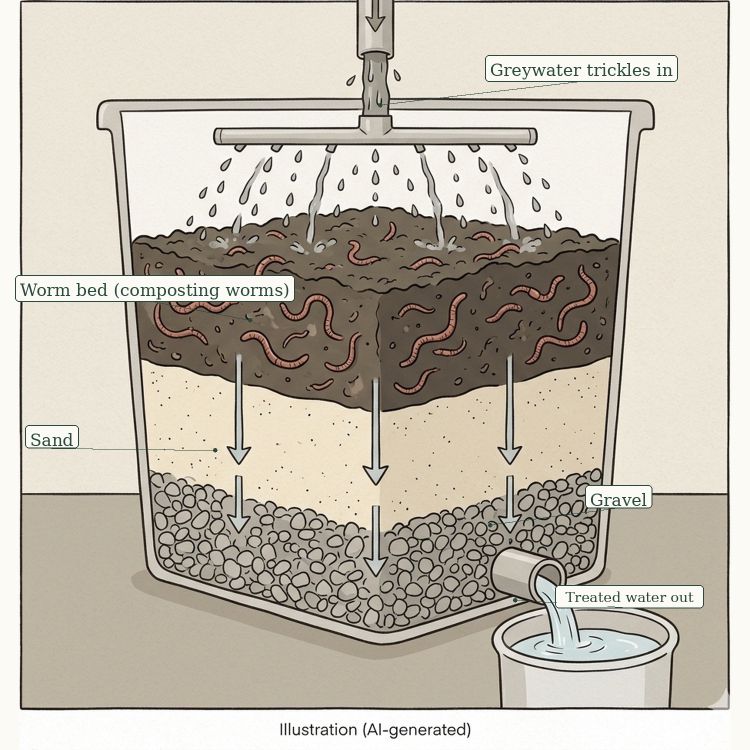
Pass dirty water through a bed of worms and it comes out dramatically cleaner — with almost no energy and no sludge.
At a glance Origin: Developed by Dr. José Tohá Castellá at the Universidad de Chile in 1992 (the lombrifiltro, or “Sistema Tohá”); spread internationally from 2008 by Rajiv K. Sinha and colleagues. · Maturity: Scaled — thousands of household “Tiger Toilet” units in India and NGO deployments in several countries; mostly decentralised. · What it needs: A bed of gravel, sand and organic material, composting earthworms, and a way to trickle wastewater through it. · Energy: Little or none — gravity-fed; a pump only if water can’t flow down. · License: Open.
The story. Earthworms turn out to be excellent water engineers. Pass dirty water slowly down through a bed of worms and filter media, and the worms and the microbes living alongside them eat the organic waste — leaving the water dramatically cleaner and, unlike a conventional treatment plant, leaving almost no sludge behind. The idea was developed by Dr. José Tohá Castellá at the Universidad de Chile in 1992 — in Spanish the lombrifiltro, or “Sistema Tohá” — and was studied and promoted internationally from 2008 by Rajiv K. Sinha and colleagues. Its best-known everyday form is the “Tiger Toilet,” a household pour-flush toilet with a worm bed underneath, thousands of which are now in use in India.
The problem it solves. Billions of people lack safe sanitation and safe water, and conventional sewage treatment is expensive, energy-hungry, and leaves sludge behind. Small communities and households often cannot afford it. Vermifiltration offers decentralised treatment that needs little or no energy and produces no sludge — just cleaner water and a useful compost.
What you need. A container or lined bed; a bottom layer of gravel; a middle layer of sand; and a thick top “vermibed” of organic material (wood chips, sawdust, coir, bark, or straw) where the worms live. Composting earthworms (Eisenia fetida is most common). A way to apply the wastewater slowly across the top, and a pipe to collect the treated water below. A vermibed depth of around 60 cm is commonly recommended. Low material cost and little or no energy — but it is a living system that needs tending: keep the bed moist but not flooded, keep anything toxic to worms out, and harvest castings as they build up.
How to build and use it. Follow the authoritative free how-to at Vermifilter.com for the full build. In outline: build a bed with gravel at the bottom, sand above, and a thick organic vermibed on top stocked with composting worms. Apply the wastewater slowly across the surface so it trickles down rather than ponding — the trickling keeps the bed aerated, which is essential. Collect the treated water from the drain below, keep the bed moist (about 60–75% moisture), keep it shaded and well below 35 °C, and harvest castings periodically. Typical loading is about 1.5–2.5 m³ of wastewater per square metre of bed per day.
What to expect — and what NOT to expect. Figures vary by design and scale, so treat these as ranges. The clearest honest comparison: with earthworms present, COD drops about 80–90%, against only 15–25% in the same bed without worms — the worms do the work. A 2017 study of a small single-stage worm filter treating town wastewater (Lourenço and Nunes) removed about 91% of BOD, 80 to 88% of COD depending on the filter material, and 98% of suspended solids, and it removed all worm eggs. But it could not bring faecal bacteria down to the WHO guideline values for irrigating with treated wastewater. Do not use water from a filter like this on food crops without further treatment. The household Tiger Toilet has been measured at about 99% faecal-coliform reduction. Conditions required: warmth but not heat. The usual worm, Eisenia fetida, does best at about 20 to 25 °C and only tolerates up to about 35 °C, so keep the bed well below that. (One 2024 review of worm filters gives 25 to 35 °C as the working range for the filter; the worms themselves are safer at the cooler end.) Also needed: a moist-not-flooded bed, oxygen (the water must trickle, not pond), a gentle loading rate, and influent that isn’t toxic to worms. Does NOT work: cold or baking heat kills the worms, so freezing winters or unshaded hot climates need protection; salty or chemically harsh wastewater kills them too — this is for domestic and organic wastewater, not industrial effluent with heavy metals or high salinity. Common failures: clogging is the most common — solids and surface sludge choke the bed; avoid it with coarse, well-drained media, no overloading, and a healthy worm population. Not suitable for industrial or chemically contaminated water, or unprotected sites at temperature extremes.
Where it has been used. India — “Tiger Toilet” household units, by 2017 — over 2 000 installed; about 99% faecal-coliform reduction. India — Sinha et al. pilot, ~2008 — vermifiltration of up to ~1 000 m³/day of sewage. Liberia and others — Oxfam “tiger worm toilets” in refugee camps and peri-urban areas. Ghana, Australia and New Zealand — domestic and community systems sold and serviced.
How it continues. Dr. José Tohá Castellá (Universidad de Chile, 1992); spread internationally by Rajiv K. Sinha and colleagues from 2008. Maintained now by households (Tiger Toilets), NGOs (Oxfam), and commercial suppliers. Vermifilter toilets are designed to be low-maintenance — the worms largely sustain themselves if fed and kept in range — and thousands remain in use; independent long-term and large-scale data is still developing.
Built or used a worm filter or tiger toilet? Tell us how it went — what you built it from, how it performed, whether it worked where you are, what you’d change, and roughly where and when. We want the honest result, including what didn’t work. Your contact details stay private; we read and check every report before anything is published, and we’ll never publish a detail you’ve asked us to keep private.
Sources: Wikipedia, “Vermifilter” (en.wikipedia.org/wiki/Vermifilter) · Sinha et al. (2008), Environment Systems and Decisions, doi.org/10.1007/s10669-008-9162-8 · Banerjee, Madhogaria, Saha, Kundu and Dhak, “Vermifiltration: an opportunity to improve wastewater treatment—a sustainable and natural approach”, Discover Water 4:47, 2024 — https://doi.org/10.1007/s43832-024-00101-0 (archived: https://web.archive.org/web/20250607211201/https://link.springer.com/article/10.1007/s43832-024-00101-0) · Mahmood and colleagues, “Natural Treatment Systems as Sustainable Ecotechnologies for the Developing Countries”, BioMed Research International, 2013 (Table 2, earthworm temperature ranges) — https://pmc.ncbi.nlm.nih.gov/articles/PMC3708409/ (archived: https://web.archive.org/web/20250328030359/https://pmc.ncbi.nlm.nih.gov/articles/PMC3708409/) · N. Lourenço and L. M. Nunes, “Is filter packing important in a small-scale vermifiltration process of urban wastewater?”, International Journal of Environmental Science and Technology 14, pages 2411–2422 (2017) — https://doi.org/10.1007/s13762-017-1323-1 (archived: https://web.archive.org/web/20250803041541/https://link.springer.com/article/10.1007/s13762-017-1323-1 ) · abstract in the University of Algarve repository: https://sapientia.ualg.pt/entities/publication/3b199736-d303-4b2c-b62a-8a786fdf8eac (archived: https://web.archive.org/web/20241113142055/https://sapientia.ualg.pt/entities/publication/3b199736-d303-4b2c-b62a-8a786fdf8eac ) · Vermifilter.com (build how-to).