Ticino Biomasa — A Town Powered by Peanut Shells
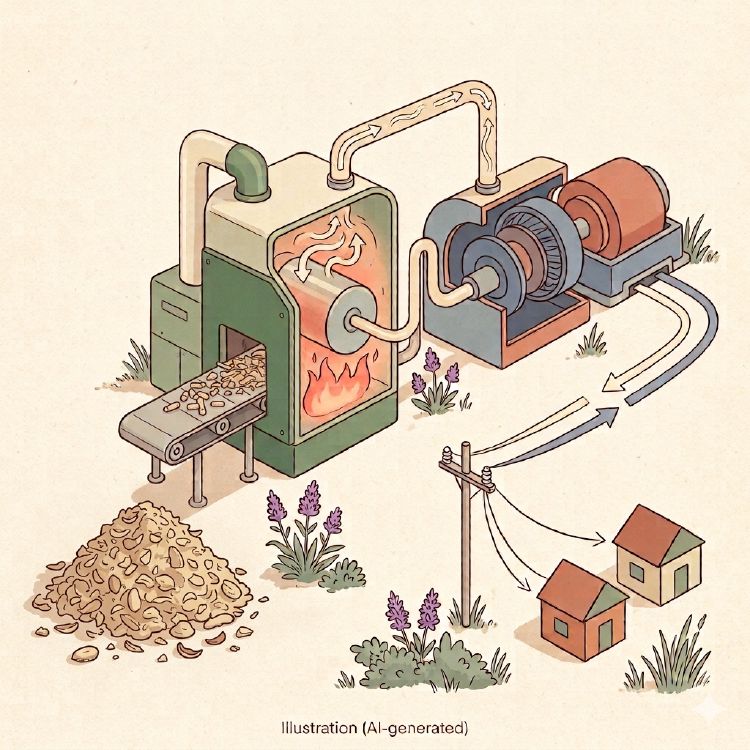
Ticino is a small town in Argentina’s peanut country, and peanut processing leaves mountains of shells. Instead of treating the shells as waste, a local company built a power plant that burns them: the shells raise steam, the steam drives a turbine, and the turbine makes electricity — enough for far more households than the town itself holds. When Argentina’s national grid went dark in country-wide blackouts, Ticino kept its lights on.
At a glance Origin: Ticino, Córdoba Province, Argentina · Maturity: a commercial plant running since August 2018 · Scale: about 5 MW installed (4.63 MW by the operator’s own figure); enough for about 8 000 homes, fed into the national grid · Licence: the plant is a private asset; the underlying idea is open.
The story, and why it’s here. This is a Lane 3 story because it is an industrial plant owned by a peanut-processing company, not a village build. What makes it worth telling is the move at its heart — turning a locally abundant crop residue into reliable power — and the resilience that came with it. The plant is rated at about 5 MW; it needs about 40 000 tonnes of peanut shell to produce 3 MW, and about 1 MW runs the company’s own peanut plant. It was among the first projects in Córdoba awarded under RenovAr 2, Argentina’s national renewable-energy auction: it bid US$110 per megawatt-hour and holds a 20-year contract to supply the national grid, it makes enough for about 8 000 homes, far more than a town of about 3 000 people uses. When the national grid failed, in June 2019 and again on 1 March 2023, a protocol switched Ticino onto a closed circuit fed by the plant, and the town kept its lights on.
What to take from it — honestly. The transferable idea is matching a power plant to a local waste stream — peanut shells here, but rice husk, sawmill offcuts or bagasse elsewhere. That idea scales down in principle; this particular plant does not, because it is industrial and capital-intensive. Burning biomass is lower-carbon only when the residue would otherwise rot or be burned anyway, and it is not emission-free. The capacity and reach figures come from reporting and the company, not from an independent audit. When peanut shell runs short, the plant sometimes burns wood chip instead — the waste stream that makes it work is also its limit.
Who made it. Generación Ticino Biomasa, part of the peanut company Lorenzati, Ruetsch y Cía, with Fabio Bruschini as president.
Seen a plant like this — a local crop residue turned into power? Tell us how it went — what residue, how steady the supply was, how reliable the power proved, what you’d change, and roughly where and when. We want the honest result, including what didn’t work. Your contact details stay private; we read and check every report before anything is published, and we’ll never publish a detail you’ve asked us to keep private.
Sources: Origlia, “Con la cáscara de maní, por segunda vez un pueblo cordobés logró salvarse del apagón”, La Nación, 4 March 2023 (Spanish) — https://www.lanacion.com.ar/economia/campo/ticino-pueblo-cordobes-se-salvo-del-apagon-nid2259006 (archived: https://web.archive.org/web/20251016194655/https://www.lanacion.com.ar/economia/campo/ticino-pueblo-cordobes-se-salvo-del-apagon-nid2259006) · “Ticino, el pueblo que se ilumina con cáscara de maní”, Editores, October 2025 (Spanish) — https://www.editores-srl.com.ar/sites/default/files/berizzo_20251012_generacion_de_energia_electrica_a_partir_de_la_biomasa.pdf (archived: https://web.archive.org/web/20261115220047/https://www.editores-srl.com.ar/sites/default/files/berizzo_20251012_generacion_de_energia_electrica_a_partir_de_la_biomasa.pdf) · Vía País, on how Ticino generates power from peanut shell (Spanish) — https://viapais.com.ar/cordoba/como-es-ticino-el-pueblo-que-genera-energia-con-cascara-de-mani-y-no-sufrio-los-dos-grandes-apagones-del-ultimo-tiempo/ (archived: https://web.archive.org/web/20250929194304/https://viapais.com.ar/cordoba/como-es-ticino-el-pueblo-que-genera-energia-con-cascara-de-mani-y-no-sufrio-los-dos-grandes-apagones-del-ultimo-tiempo/)