Sand Dams — Banking a Season’s Water Inside the Sand
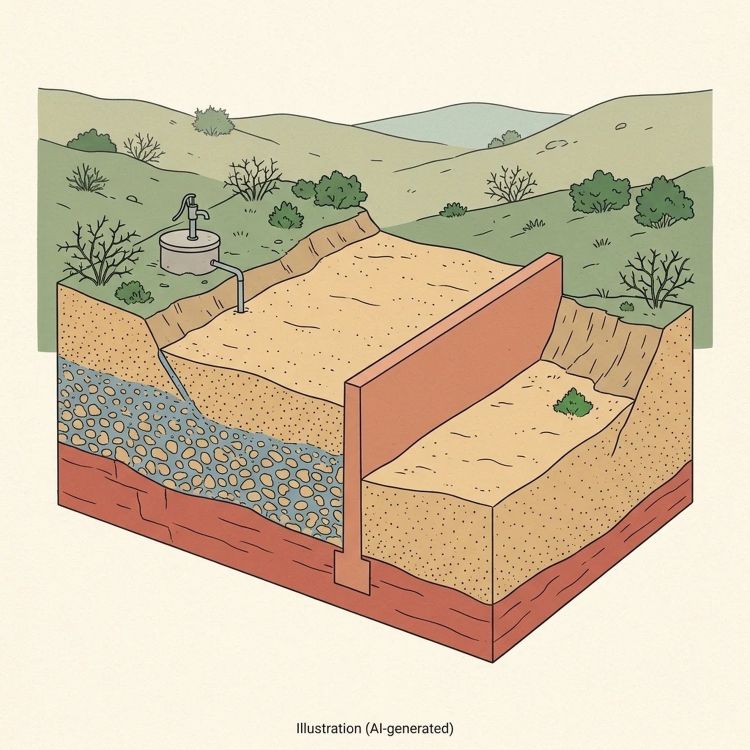
In dryland Kenya a river runs only in the rains and vanishes for months. A sand dam is a low, strong wall built across such a seasonal riverbed. When the river flows, it drops its sand behind the wall; the sand piles up and, crucially, holds water in the spaces between its grains — a buried reservoir that doesn’t evaporate away and that a community can draw on through the dry season.
At a glance Origin: southeast Kenya (Kitui and Makueni), spread by Sand Dams Worldwide (formerly Excellent Development) and the communities themselves · Maturity: Scaled · Effort: significant community labour to build; low running cost after · Licence: open.
How it works. A reinforced wall, built down to solid bedrock across the riverbed, traps the coarse sand the river carries. Over one or several rainy seasons the sand fills in behind the wall, and water fills the gaps between the grains — a well-sited mature dam can store on the order of 6 000 m³ of water. Because the water sits inside sand, it loses far less to evaporation than an open pond. The sand filters out some dirt, but it does not make the water safe to drink. In a study of sand dams in southeastern Kenya, water from open scoop holes was often contaminated with faecal bacteria, while water from covered wells was much cleaner; even so, both were cloudier than the World Health Organization advises. Treat the water before drinking it, and draw it through a covered well or a pipe rather than an open hole.
What to expect — and what it does NOT do. Where it works, a sand dam can turn a months-long dry season into a year-round water source for a community. But siting is make-or-break, and this is the honest heart of the entry: it needs the right kind of seasonal, sand-carrying river on an impermeable base, built in the right spot. On the wrong river, or the wrong place on the right river, a sand dam simply fails — the water leaks away or the sand never banks. It is not a solution for every dry riverbed, and a badly sited dam is wasted labour. A 2023 study of three sand dams in southeastern Kenya also found that the water needs treating and disinfecting before household use. It found that the smallest dams, about 68 to 80% of those built in its study area, did not hold water for long.
Who made it. Sand dams of this kind took hold in southeast Kenya through Joshua Silu Mukusya (1949–2011), a farmer and development worker, and the Utooni self-help group he formed in 1978 (some accounts give 1980), the forerunner of today’s Utooni Development Organization. They were carried widely by Sand Dams Worldwide (formerly Excellent Development) and by the communities of Machakos, Makueni and Kitui, who built and refined thousands of them. It is a community achievement, not one engineer’s.
Used it? Tell us how it went — where you built it, how you chose the site, how much water it banked, whether it lasted the dry season, what you’d change, and roughly where and when. We want the honest result, including what didn’t work. Your contact details stay private; we read and check every report before anything is published, and we’ll never publish a detail you’ve asked us to keep private.
Sources: Excellent Development’s sand-dam manuals and guidance (excellentdevelopment.com) · Appropedia’s sand-dam pages (appropedia.org) · Quinn, Avis, Decker, Parker and Cairncross, “An Assessment of the Microbiological Water Quality of Sand Dams in Southeastern Kenya”, Water 10(6), 708, 2018 — https://doi.org/10.3390/w10060708 (archived: https://web.archive.org/web/20260915063443/https://www.mdpi.com/2073-4441/10/6/708) · Ndekezi, Kaluli and Home, “Performance evaluation of sand dams as a rural rainwater conservation and domestic water supply technology in East-African drylands, a case-study from South-Eastern Kenya”, Cogent Engineering 10(1), 2023 — https://doi.org/10.1080/23311916.2022.2163572 (archived: https://web.archive.org/web/20230115171551/https://www.tandfonline.com/doi/full/10.1080/23311916.2022.2163572) · Charity Commission for England and Wales, Sand Dams Worldwide Limited, charity 1094478 — https://register-of-charities.charitycommission.gov.uk/en/constituency-search/-/charity-details/3992698/governance (archived: https://web.archive.org/web/20261117001850/https://register-of-charities.charitycommission.gov.uk/en/constituency-search/-/charity-details/3992698/governance) · WOCAT, sand dam technology record — https://qcat.wocat.net/en/wocat/technologies/view/permalink/2228 · Utooni Development Organization, “Sand dams for climate resilience and food security in arid and semi-arid landscapes” (PANORAMA) — https://panorama.solutions/fr/node/3368