Azolla: A Water Fern That Feeds a Rice Paddy With No Fertilizer Bill
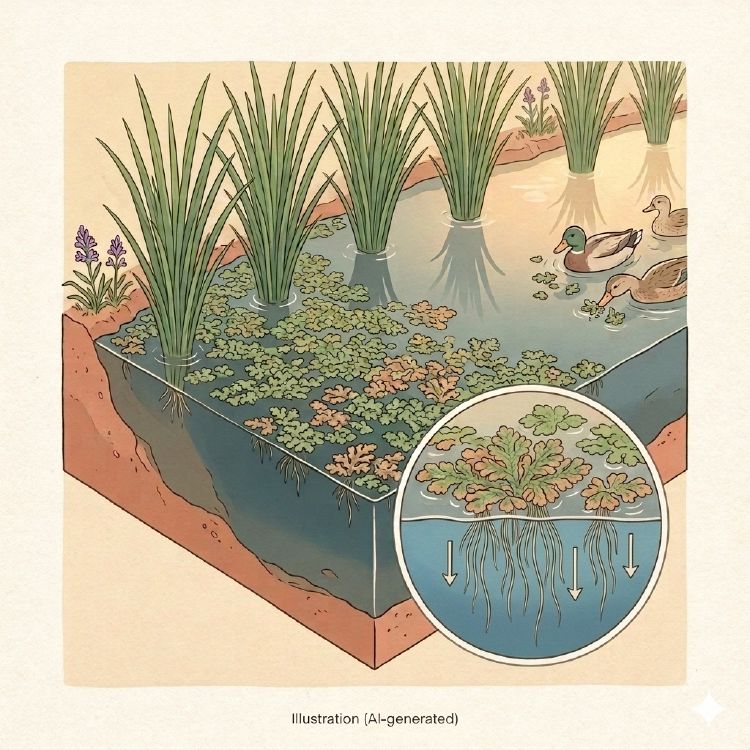
Floating on the water of a rice paddy, the tiny fern Azolla does something unusual: with the help of a partner bacterium it pulls nitrogen straight out of the air, the same nutrient farmers pay for in a fertilizer sack. Asian rice farmers have used it for centuries as a living green manure and as feed for their animals, with no seed or fertilizer to buy. Synthetic fertiliser pushed it aside; a changing climate and fertilizer prices are bringing it back.
At a glance Origin: a traditional practice across East and Southeast Asia · Maturity: Scaled · Effort: low cost, but real work to manage the fern and the water · Licence: open.
How it works. Grown on the standing water of a paddy, Azolla doubles its mass in a few days and builds a green mat. Worked into the mud or left to decompose, it releases its nitrogen to the rice; skimmed off, it feeds ducks, pigs, fish and poultry. It makes its own nitrogen, so there is no fertilizer to buy, as long as the conditions suit it. The work is real, though: someone has to start the fern, keep the water standing in the paddy, and then work the fern into the mud or skim it off.
What to expect — and what it does NOT do. Used well, it can raise a rice harvest a great deal: the Azolla Foundation says by more than 50%. How much depends on the paddy, the climate and how the fern is managed, so there is no single figure to promise. The limits are real and biological, not accidents: it needs standing water, warmth (it does best around 25–30 °C and struggles in cold or extreme heat), and phosphorus in the water to thrive. Where the water dries up, the climate is wrong, or phosphorus is lacking, it won’t perform — and that is a true constraint, not a documentation gap. Azolla also soaks up heavy metals, such as lead, cadmium and mercury, from the water it grows in. Researchers use it to clean polluted water for exactly that reason. So never feed animals, or eat, azolla grown in water that may carry metals: water from mines, factory drains or sewage.
Who made it. No single inventor — a shared practice of generations of Asian rice farmers. In Vietnam (where it is called bèo hoa dâu) the agronomist Nguyễn Thị Trâm has worked to revive it, named here alongside, not above, the farmers who kept it alive.
Used it? Tell us how it went — how you grew it, whether it lifted your rice or fed your animals, how it handled your climate, what you’d change, and roughly where and when. We want the honest result, including what didn’t work. Your contact details stay private; we read and check every report before anything is published, and we’ll never publish a detail you’ve asked us to keep private.
Sources: the Azolla Foundation, “Rice production” — https://theazollafoundation.org/azollas-uses/in-rice-production/ (archived: https://web.archive.org/web/20261117001826/https://theazollafoundation.org/azollas-uses/in-rice-production/) · FAO biofertiliser guidance (fao.org) · Vietnamese-language growing guides (asiaorganic.org) · Sood, Uniyal, Prasanna and Ahluwalia, “Phytoremediation Potential of Aquatic Macrophyte, Azolla”, Ambio 41(2), 2012 (online 2011) — https://pmc.ncbi.nlm.nih.gov/articles/PMC3357840/ (archived: https://web.archive.org/web/20260321090455/https://pmc.ncbi.nlm.nih.gov/articles/PMC3357840/) · Lestari and colleagues, “Azolla for Water and Land Phytoremediation Against Heavy Metals: A Mini Review”, BIO Web of Conferences 104, 2024 — https://doi.org/10.1051/bioconf/202410400042 (archived: https://web.archive.org/web/20260315173342/https://www.bio-conferences.org/articles/bioconf/abs/2024/23/bioconf_icon-beat2024_00042/bioconf_icon-beat2024_00042.html)